Search engine visitors - click here to access entire web site
Click here to see a descriptive illustration of several types of new insulation.
Related links - House Insulation Tips and Quantity Guide
Dear Jim: My utility bills are high and I am adding a room to my house. I want to insulate the room properly and also add more insulation in rest of the house. What type of insulation is best and is this worthwhile? - Gary M.
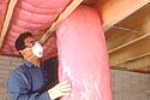
A: Having proper insulation throughout your house is imperative in order to have reasonable utility bills. Insulation not only reduces the energy loss during winter (gain during summer), but it can also make you feel more comfortable by keeping the indoor wall surface warmer during winter or cooler during summer.
There is nothing more uncomfortable than sitting near a cold, uninsulated outside wall or window during winter. This because the surface of your skin loses heat energy by radiation to the cold surface even though the room air temperature is adequately high for comfort. When you are uncomfortable, you often set the thermostat a little higher (lower during summer) and this increases your utility bills.
When installing most residential insulation materials, the amount of the insulation (final installed R-value) is generally more important than the type of insulation you select. This is particularly true in an open area, such as the attic floor, where the amount installed is not limited by the width of the opening as it is inside of a wall or floor. Your local insulation contractor or building inspectors can advise you about the recommended amounts of insulation for your climate or check the www.doe.gov (Department of Energy) web site.
Although you often hear the amount of insulation quoted in inches of thickness, the true measure of insulation is its final installed R-value. The insulation properties of various materials vary significantly so the inches installed does not really tell you very much. In addition to the material itself, the quality of the installation job (minimizing voids) is important for the maximum savings.
Assuming the insulation is installed according to the manufacturer's recommendations, most fiberglass, mineral wool and cellulose insulation has an R-value of about three to four per inch thickness. Fiberglass and mineral wool can be installed as batts or blown into the cavity or on the attic floor. Some polyurethane foam insulation materials, such as Corbond, can provide more than R-7 per inch thickness.
When you talk with various insulation contractors, make sure they quote the final installed R-value of the insulation you are getting. Particularly with blown-in loose-fill insulation, the density can be too low. This means you get a lot of inches of depth, but the resultant insulation R-value is not as high as you expected. All reputable insulation contractors should provide a quote based on the final R-value.
For your attic, blown-in insulation is always a good choice. This can be fiberglass, rock wool or cellulose. The cellulose is treated with fire retardants so it is safe for residential use. In fact, you can rent insulation blowers for cellulose and install it yourself. Whether you install it or hire a professional contractor, make sure there are baffles over the attic soffit vent inlets. These keep the insulation from blowing over them and blocking the air flow.
For the walls in your new room, consider batt insulation if you are doing the insulating job yourself. The batts are sized properly to fit normal wall stud spacing. Batts with the vapor barrier already attached are simple to install and they form a reasonable vapor seal. Covering the wall with film seals even better. If you are an environmentalist as I, use batt insulation made from recycled cotton made with denim waste from manufacturing. The cotton is treated for fire safety.
Sprayed-on urethane foam insulation offers the highest insulation levels for limited space inside a framed wall. Closed-cell foams are best because they form their own vapor barrier. Another option is blown-in fiberglass or mineral wool mixed with a resin material. Once it is blown into the walls, the resin sets up and so the insulation will not settle eliminating future voids. A small void area can lose a lot of energy. If the wall is already closed in, standard blown-in insulation is a good option.
For both new and existing walls, adding rigid foam board insulation to the exterior is best. This is ideal and simple to do if you are residing a house. Any type of exterior finish can be applied over the insulation board similarly to over wood sheathing. It is particularly effective to have the insulation on the exterior because the thermal mass of the entire wall structure is within the insulation envelop.
Instant Download Update Bulletin No. 602 - buyer's guide of 10 do-it-yourself new earth-friendly, high-density, foam wall and attic insulation manufacturers, installation methods, R-values, thickness, sizes available, insulation selector guide, installation instructions for batt insulation and a U.S. map showing recommended insulation levels.
Dear Jim: There are wide (1/8 inch), deep cracks in my asphalt driveway. I treated it with sealer last week, but the cracks were not filled. Will some old dark roof caulk work in the cracks? - Bob W.
A: It is important to fill deep cracks, particularly in cold climates. Even during subfreezing temperatures, blacktop get warm enough in the sun to melt ice. This water gets into the crack and refreezes every night. This will gradually destroy the driveway.
I guess roof caulk might work. It would be better to use a driveway crack sealer. It is a thick tar-like liquid with a sand base. Apply it several times because it shrinks as it dries.